
Table of Contents
- Why Airport Car Service Metrics Matter for Your Business
- Core KPIs That Define Reliable Chauffeur Services
- On-Time Performance: The Foundation of Professional Service
- Fleet Quality and Vehicle Maintenance Standards
- Driver Training and Customer Service Excellence
- Customer Satisfaction Scores in Premium Transportation
- Safety Records and Compliance Tracking
- Passenger Feedback Systems and Continuous Improvement
- Technology Integration for Service Optimization
- How We Measure and Monitor Our Performance
- Translating Metrics Into Superior Passenger Experiences
- Choosing an Airport Car Service That Prioritizes Measurable Excellence
- Frequently Asked Questions (FAQ)
Why Airport Car Service Metrics Matter for Your Business
Luxury transportation isn’t just about arriving in style. It’s about arriving reliably, safely, and with a level of service that reflects your professional standards. For business travelers and corporate teams, airport car service quality directly impacts your schedule, reputation, and bottom line.
We know that missed pickups, delayed vehicles, or unprepessional behavior ripple through your entire day. That’s why we measure and monitor specific performance indicators across every touchpoint. When you understand what makes a premium car service truly excellent, you can demand those standards and verify them consistently.
The metrics that matter aren’t vanity numbers. They’re operational data points that reveal whether your transportation partner is genuinely reliable or merely adequate. A chauffeur service that tracks these KPIs demonstrates accountability and a culture of continuous improvement.
Core KPIs That Define Reliable Chauffeur Services
The foundation of any quality chauffeur service rests on a handful of measurable indicators. We focus on metrics that directly affect your experience:
- On-time arrival rate: The percentage of pickups completed within the scheduled window (typically within 5 minutes).
- Fleet availability: How many vehicles are operational and ready to deploy at any given time.
- Driver retention rate: Staff turnover impacts consistency; experienced drivers deliver better service.
- Customer retention: Whether clients return for repeat bookings reflects overall satisfaction.
- Incident rate: Safety violations, accidents, or complaints per 1,000 miles driven.
Each metric tells a story. A high on-time rate without fleet availability data might mask chronic scheduling problems. Driver retention without customer retention could indicate internal management issues that passengers eventually discover. We track these in concert because excellence across executive car service quality metrics requires alignment across every department.
On-Time Performance: The Foundation of Professional Service
Punctuality separates professional transportation from ordinary rideshare. For airport transfers, being on time means monitoring flight status, understanding traffic patterns, and positioning vehicles strategically before your confirmed pickup time arrives.
We establish a specific definition of on-time performance: arrival within a 5-minute window of your requested pickup. For airport transportation efficiency measures, this means we begin monitoring your flight 24 hours before departure. If your arrival is delayed, we adjust our dispatch timing accordingly. If traffic becomes problematic, we’ve already identified alternate routes.
Most quality lapses trace back to poor on-time performance. When a driver arrives late, it cascades: you’re rushing, stress increases, the experience feels chaotic despite the luxury vehicle. When consistency exists, everything else becomes possible. Your morning commute or airport transfer becomes predictable, freeing you to focus on what matters.
Track this metric weekly. Request reports from your service provider. If on-time performance dips below 95%, that signals operational issues requiring immediate attention.
Fleet Quality and Vehicle Maintenance Standards
The vehicle itself communicates professionalism before a word is spoken. A well-maintained luxury car with pristine interiors, functioning climate control, and working amenities sets the tone for the entire journey.

We conduct pre-trip inspections on every vehicle: exterior condition, interior cleanliness, fuel level, tire pressure, and all mechanical systems. Post-trip inspections catch any damage or mechanical concerns before the next passenger boards. This isn’t occasional; it’s documented and systematic.
Vehicle age matters too. Premium transportation typically means models less than five years old, with luxury marques maintained to original specifications. Worn seats, dated technology, or obvious repairs undermine the entire experience. We retire vehicles that no longer meet our standards rather than extend their service life.
Establish benchmarks: vehicles should be cleaned between passengers, never travel more than 100,000 miles without major service review, and be replaced on a predictable cycle. Ask your provider about their fleet refresh schedule and maintenance documentation.
Driver Training and Customer Service Excellence
Your chauffeur represents your professional brand. Beyond operating a vehicle safely, they’re managing your schedule, protecting your privacy, and delivering discretion that corporate travelers expect.
We implement comprehensive driver training covering defensive driving, passenger etiquette, crisis management, and confidentiality. New drivers complete classroom instruction, supervised road time, and evaluation before handling premium clients. Ongoing education addresses seasonal challenges, new vehicle systems, and service standards.
The best drivers anticipate needs without being intrusive. They know when conversation is welcome and when silence is preferred. They arrive early enough to offer assistance but wait for guidance. They remember passenger preferences and communicate proactively about traffic delays or route adjustments.
When evaluating a chauffeur service, ask about driver vetting, background screening (federal, state, local checks), training requirements, and performance evaluation methods. Drivers should hold commercial licenses and clean driving records spanning at least five years.
Customer Satisfaction Scores in Premium Transportation
Satisfaction metrics reveal the gap between what you expect and what you experienced. Unlike generic five-star ratings, structured satisfaction surveys capture specific dimensions: punctuality, professionalism, vehicle condition, communication, and safety.
We measure net promoter score (NPS), which asks a simple question: How likely are you to recommend our service? Scores above 70 indicate genuine satisfaction; scores below 50 suggest significant issues. We also track satisfaction by service type (airport transfers, corporate events, hourly charters) because performance varies based on operational complexity.
Satisfaction doesn’t equal retention. A passenger might rate a single trip highly but switch providers for convenience or cost. Conversely, a loyal client might note minor frustrations in surveys while remaining committed. We analyze patterns: Which service types score lowest? Do repeat clients score higher? Which drivers or routes generate feedback themes?
Request your provider’s satisfaction results and trend data. Improving scores indicate a service committed to getting better. Flat or declining scores suggest complacency.
Safety Records and Compliance Tracking
Every journey involves risk, and professional transportation companies manage that systematically. Safety metrics include accident rates, moving violations, passenger incident reports, and regulatory compliance status.
We maintain detailed incident reports documenting any accident, mechanical failure affecting service, or customer safety concern. These records are reviewed monthly to identify patterns. A single minor incident is normal; clusters of similar incidents signal a training gap or procedural issue requiring intervention.
Compliance tracking includes vehicle inspection certifications, driver licensing records, insurance coverage verification, and regulatory audits. In some jurisdictions, airport transportation services require specific permits or operational licenses. Legitimate providers maintain these actively and can document compliance immediately.

Verify your provider’s insurance coverage limits, check their incident history if available, and confirm they meet all local airport transportation regulations. Ask for their safety record over the past 24 months.
Passenger Feedback Systems and Continuous Improvement
Feedback without action is just data collection. Genuine quality improvement requires systematic processes for gathering input, analyzing themes, and implementing changes.
We invite passenger feedback after every trip through multiple channels: digital surveys, email follow-up, and direct driver communication. We categorize feedback by theme (vehicle issues, driver behavior, communication, timing) and track resolution. If a pattern emerges (e.g., frequent comments about temperature control), we investigate and address the root cause.
Continuous improvement becomes visible when passengers notice changes. If weather-related delays are mentioned frequently, a provider might implement earlier pickup times during forecasted storms. If clients note difficulty reaching a dispatcher, online booking systems might be enhanced.
The best providers publish improvement initiatives. You might hear: “Based on passenger feedback, we’ve upgraded our vehicle fleet technology for better climate control and enhanced our communication systems for real-time delay notifications.”
Technology Integration for Service Optimization
Modern airport car services leverage technology to enhance reliability and transparency. This includes real-time GPS tracking, automated flight monitoring, digital dispatch systems, and passenger communication platforms.
We use flight tracking integration to automatically adjust pickup times as aircraft status changes. Our dispatch system optimizes driver routing based on traffic patterns and vehicle location. Passengers receive proactive notifications: driver has been assigned, vehicle is en route, estimated arrival time, and real-time updates if delays occur.
Technology should enhance the experience, not replace human judgment. Automated systems can fail or misinterpret data. The best providers use technology to augment driver expertise, not substitute for it. A driver with GPS guidance still needs local knowledge and the judgment to choose an alternative route when unexpected congestion appears.
Ask about your provider’s technology infrastructure. Can you track your vehicle? Do you receive proactive flight-based updates? Is the booking system user-friendly and available 24/7?
How We Measure and Monitor Our Performance
At Pompeii Limousine, we track these metrics through integrated systems and regular reviews. Our dispatch software logs every pickup time, arrival time, and passenger feedback. Vehicle maintenance records are digitized and flagged for preventive service. Driver performance is evaluated continuously through passenger surveys and supervisor observation.
We establish targets for each metric and measure actual performance against those targets monthly. When performance falls short, we investigate root causes and implement corrective action. This might involve additional driver training, vehicle maintenance, scheduling adjustments, or process refinement.
Our clients receive quarterly performance reports showing their specific metrics: on-time performance, vehicle quality ratings, driver satisfaction scores, and any incidents or concerns. Transparency builds trust and creates accountability.
We also benchmark ourselves against industry standards for luxury transportation. This ensures we’re not just comparing ourselves internally but maintaining competitive excellence in the broader market.
Translating Metrics Into Superior Passenger Experiences
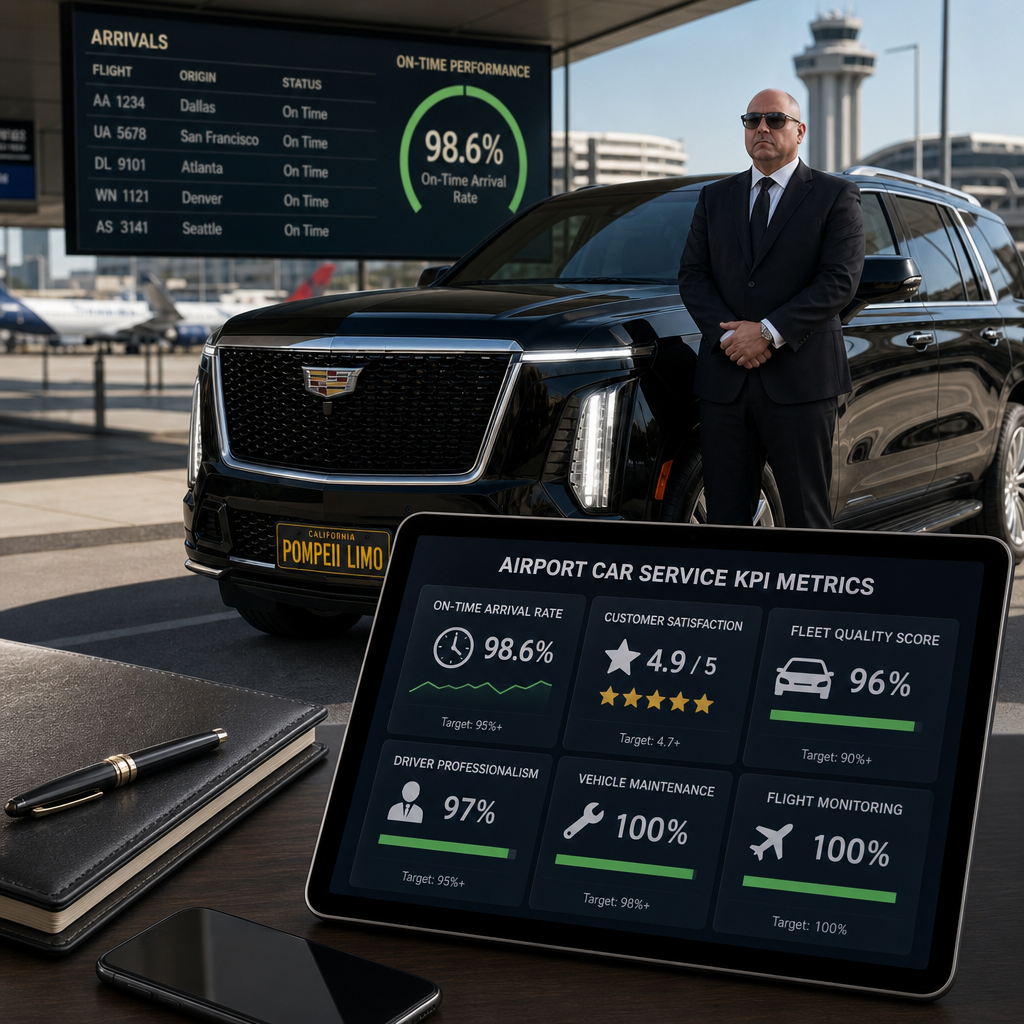
Numbers only matter if they translate to tangible improvements in how you experience our service. A 97% on-time performance rate means you can confidently schedule meetings around airport pickups. A 9.2 NPS score means most passengers would actively recommend us. A documented fleet maintenance program means you’ll never encounter vehicle issues during your journey.
These metrics compound. Reliable timing plus professional drivers plus well-maintained vehicles plus proactive communication creates an experience that feels effortless. You board a vehicle precisely when expected, find it immaculate and comfortable, interact with a courteous professional, and arrive at your destination refreshed rather than stressed.
Our premium San Diego airport chauffeur service demonstrates this in practice. Every aspect, from the initial booking to post-trip follow-up, reflects our commitment to measurable excellence.
Choosing an Airport Car Service That Prioritizes Measurable Excellence
When evaluating an airport car service provider, look beyond marketing claims to actual performance data. Request specific metrics: on-time rates, customer satisfaction scores, driver retention, fleet age, maintenance records, and safety documentation. Legitimate providers share this information without hesitation.
Schedule a test ride. Experience the service firsthand. Does the driver arrive early? Is the vehicle impeccably maintained? Do you feel the vehicle and driver reflect professional standards? Does the experience feel orchestrated or chaotic?
Ask about their improvement processes. How do they identify issues? What recent changes have they implemented based on feedback? Providers committed to excellence can point to specific examples of evolution and refinement.
Consider your specific needs. If you require frequent airport transfers, prioritize on-time performance and fleet availability metrics. If you need confidential executive transportation, driver screening and retention rates become paramount. If you travel globally, ask about their international service capabilities and how they maintain standards across different regions.
We’re here to support your transportation needs with measurable, verifiable excellence. Connect with us to discuss how our San Diego airport car service can meet your specific requirements and exceed your expectations through every journey.
Contact us today.
Frequently Asked Questions (FAQ)
What KPIs do we focus on to ensure reliable airport transportation?
We prioritize on-time performance, vehicle maintenance standards, driver training quality, and customer satisfaction scores as our core metrics. Our chauffeurs track real-time flight information to adjust pickup times, we maintain rigorous vehicle inspections, and we monitor passenger feedback continuously to identify areas for improvement. These interconnected KPIs help us deliver the consistent, professional service our clients expect from us.
How does our fleet maintenance impact the quality of service we provide?
Our vehicles undergo scheduled inspections and preventive maintenance to guarantee they meet luxury transportation standards every single time. We track maintenance records, vehicle condition reports, and fleet reliability metrics because we understand that a well-maintained car directly reflects our commitment to excellence. When we keep our fleet in pristine condition, we eliminate unexpected service disruptions and ensure our passengers experience the seamless journey we promise.
How do we use passenger feedback to improve our chauffeur services?
We actively collect feedback through multiple channels after every journey and analyze patterns in passenger comments, ratings, and suggestions. Our team uses this data to refine driver training programs, adjust service protocols, and address any gaps in our performance. This continuous feedback loop allows us to evolve our executive car service and maintain the high standards that keep our clients returning to us.


