
The drive from Los Angeles to San Diego is one of those classic Southern California experiences. On a perfect day, with no traffic, you’re looking at about a 2.5 to 3-hour trip. But let's be realistic—this 120-mile stretch of the I-5 corridor is legendary for its congestion, which can easily turn a short drive into a long haul if you hit the road at the wrong time.
Planning Your Drive from Los Angeles to San Diego
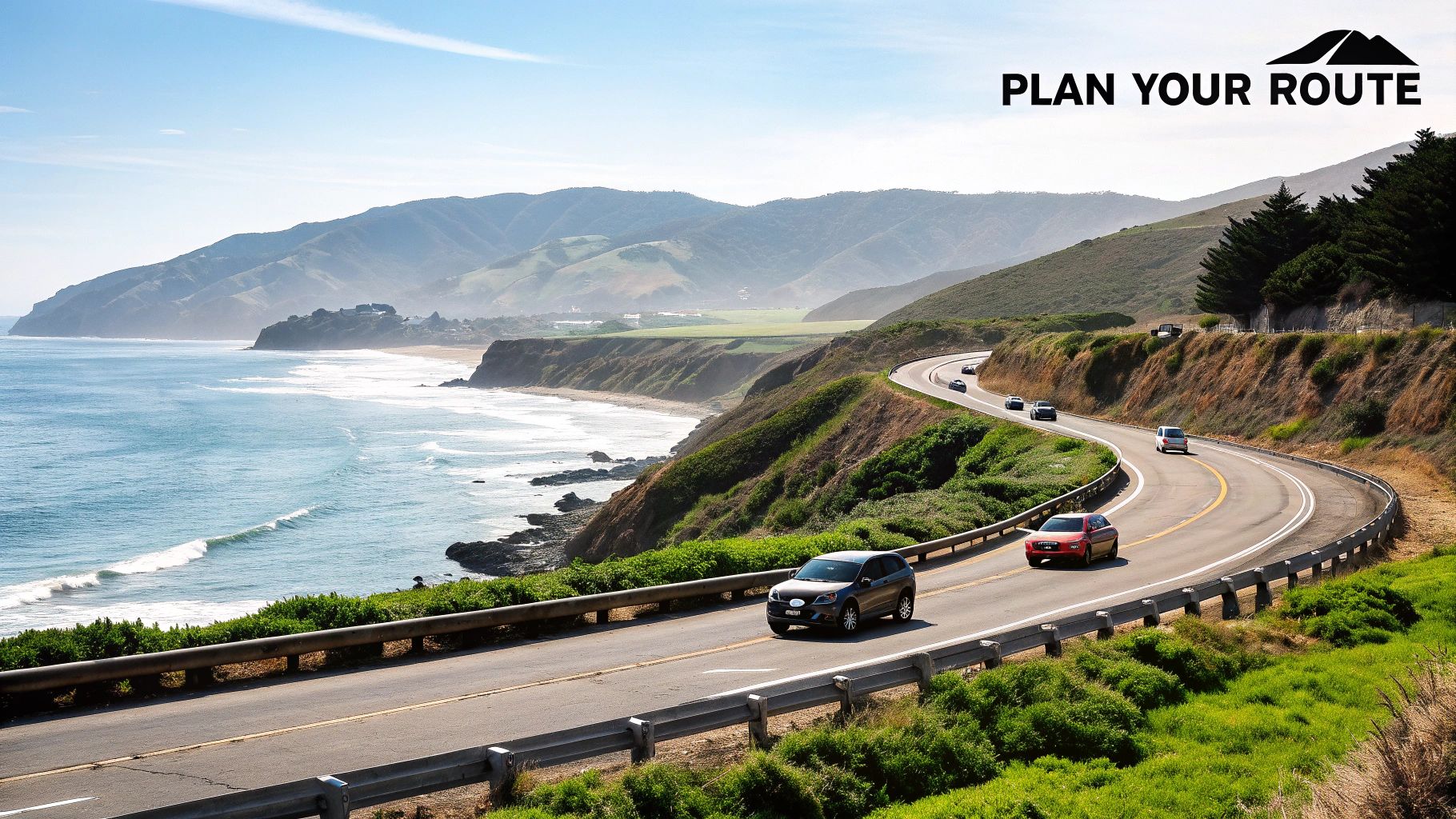
Making the drive from LA to San Diego shouldn't just be about getting from point A to point B. It’s a journey that can be either a stressful crawl or a smooth, scenic adventure—and the difference comes down to a little bit of planning. Think of this as your inside guide to navigating one of America's busiest freeway corridors like a local.
Your main option is the direct shot down Interstate 5 (I-5), but its speed is completely at the mercy of traffic. The two biggest factors in your control are the day and time you leave. A mid-morning drive on a Tuesday is a completely different world from the gridlock you'll find on a Friday afternoon.
Key Considerations for Your Trip
To make sure your journey is as memorable as the destination itself, you’ll need a solid game plan. We’ll walk you through everything you need to know to set yourself up for success, including:
- Choosing the right path: We’ll break down the pros and cons of the direct I-5 route versus more scenic alternatives, so you can pick the drive that fits your style.
- Avoiding peak congestion: You'll learn the rhythm of Southern California traffic and the best times to travel to sidestep the worst of the bottlenecks.
- Discovering worthwhile stops: From stunning coastal lookouts to charming little towns, we’ll point you to the best places to stretch your legs and make the drive part of the vacation.
The traffic patterns we see today didn't happen overnight; they're the result of over a century of explosive growth. Early in the 20th century, car registrations in Los Angeles County skyrocketed from 50,000 to half a million in just ten years, cementing the region's deep-seated reliance on the automobile.
Beyond mapping your route, there are a few other things to think about. For those considering a pet-friendly road trip, there are some great resources out there with specific tips. And once you pull into town, our https://pompeiilimousine.com/san-diego-travel-guide/ has you covered for making the most of your visit.
Comparing the Best Routes from LA to San Diego
Your first big decision when driving from Los Angeles to San Diego is picking your route, and it will absolutely shape the entire trip. Think of it like this: are you taking a direct flight to get there fast, or are you hopping on a scenic train to enjoy the journey? Each path has its own distinct Southern California flavor, complete with a unique rhythm, different views, and its own set of potential headaches.
Let's break down the three main options. This way, you can pick the one that best fits your schedule, your patience level, and your overall travel vibe. Knowing the personality of each freeway ahead of time is the key to making a smart choice.
The Direct Shot: Interstate 5
For most people, the LA to San Diego drive is all about one road: Interstate 5. The I-5 is the most direct path and, when the stars align, it's the fastest way to connect the two cities. This freeway is the workhorse of Southern California, a straight shot that plows through the middle of Orange County before hugging the coastline past Camp Pendleton.
But its directness is also its greatest weakness. The I-5 is infamous for its traffic, which can feel completely random if you're not a local. Two spots, in particular, are notorious for bringing things to a standstill:
- The Orange Crush: This is what locals call the monster interchange in Orange County where the I-5, SR-22, and SR-57 all crash together. During rush hour, this area can slow to an absolute crawl.
- Camp Pendleton: The long stretch of freeway that cuts through the Marine Corps base can get surprisingly backed up, especially if there are military exercises or on weekends when everyone from LA and San Diego decides to hit the beach.
If your only goal is speed and you can travel outside of peak hours, the I-5 is your go-to. If you're coming straight from the airport, it’s worth getting familiar with the specifics of driving from LAX to San Diego, as that adds a whole other layer of traffic to contend with.
The Scenic Detour: Pacific Coast Highway
Got some time to spare? Want to soak in those iconic California views you see in the movies? Then starting your trip on the Pacific Coast Highway (PCH) is an unbeatable choice. This route winds you through world-famous beach towns like Huntington Beach, Newport Beach, and Laguna Beach, serving up stunning ocean vistas and a much more relaxed vibe.
You won't take the PCH the entire way, of course—it’s far too slow for that. The idea is to enjoy the coastal scenery through Orange County before you merge onto the I-5 South in Dana Point to finish the drive.
This route transforms the drive from a simple A-to-B commute into a memorable part of your vacation. It’s perfect for travelers who want to make stops, take photos, and experience the laid-back culture of SoCal's beach communities.
Just be aware that this scenic path will add at least 30-60 minutes to your total drive time, and that's before you even think about stopping. On a sunny weekend, traffic in these beach towns can be surprisingly heavy.
The Inland Route: Interstate 15
If you're starting your trip from the eastern parts of Los Angeles County or anywhere in the Inland Empire (think Pasadena, Riverside, or San Bernardino), then Interstate 15 is the only logical choice. Taking the I-5 would mean driving west through a ton of traffic just to turn south.
The I-15 runs parallel to the I-5, but further inland. It takes you through a completely different landscape of rolling hills and valleys. While you'll miss the ocean views, the I-15 can often be a faster and way less stressful alternative, especially if your final stop is in one of San Diego's northern or eastern neighborhoods like Escondido or Rancho Bernardo.
Take a look at how dramatically your departure time can impact your total drive.

As you can see, leaving in the middle of the day can tack on a huge amount of time. An early morning or later evening departure is almost always the smarter play.
Route Comparison LA to San Diego
To make the decision even easier, here's a quick side-by-side look at what you can expect from each route.
| Route | Typical Drive Time (No Traffic) | Typical Drive Time (Peak Traffic) | Best For | Potential Downsides |
|---|---|---|---|---|
| I-5 (The Direct Shot) | 2 to 2.5 hours | 3.5 to 5+ hours | Speed and efficiency | Notorious traffic, especially in Orange County and Camp Pendleton. |
| PCH + I-5 (The Scenic Detour) | 2.5 to 3.5 hours | 4 to 6+ hours | Breathtaking coastal views and charming beach towns. | Significantly longer drive time; heavy local traffic on weekends. |
| I-15 (The Inland Route) | 2 to 2.5 hours | 3 to 4.5 hours | Avoiding coastal traffic; easier access from inland areas. | Lacks ocean scenery; can have its own traffic hotspots. |
Ultimately, the "best" route really depends on what you value most for your trip—getting there quickly, enjoying the ride, or just avoiding the worst of the traffic.
How to Beat Southern California Traffic

When you're driving from Los Angeles to San Diego, traffic isn't just a possibility—it's your main opponent. Forget secret backroads; winning this game is all about understanding the powerful, predictable currents of Southern California's freeway system.
Think of it like a massive river. At certain times, it flows beautifully. At others, it swells and chokes at well-known bottlenecks, bringing everything to a dead stop. This guide is your playbook for navigating that river, helping you find the path of least resistance and turn a frustrating crawl into a smooth, easy drive.
Understanding the Ebb and Flow
Traffic on the I-5 corridor has a distinct pulse. If you can learn its rhythm and travel between the beats, you’ve already won half the battle. The weekday rush hours here are legendary for a reason—they're far more intense than what you'll find in most other parts of the country.
- Southbound Morning Rush: The chaos kicks off around 6:00 AM and rages until about 9:30 AM as a massive wave of commuters heads out of LA and surges through Orange County.
- Northbound Evening Rush: The return trip is just as bad, clogging the freeways from roughly 3:30 PM to 7:00 PM. It's a slow-moving parking lot for anyone trying to get back north.
But don't assume the weekends are clear. They just have a different kind of gridlock, this one fueled by tourism and leisure. A sunny Saturday morning can feel just as jammed as a Tuesday rush hour, with Angelenos flocking south to the beaches. Come Sunday afternoon, you'll see a massive northbound migration as everyone heads home, creating yet another slowdown.
Finding Your Travel Sweet Spots
So, when is the best time for driving Los Angeles to San Diego? The trick is to aim for the moments of calm between these storms. Hitting these "sweet spots" is how a two-and-a-half-hour drive stays a two-and-a-half-hour drive.
The golden rule for this drive is to travel during off-peak, mid-day hours. Leaving between 10:00 AM and 1:00 PM on a Tuesday, Wednesday, or Thursday is almost always your best bet for a clear shot south.
If you’re an early bird, getting on the road before 6:00 AM can put you ahead of the commuter crush. More of a night owl? Waiting until after 7:30 PM usually opens up the lanes considerably. The same logic applies to weekends—start super early or leave late to bypass the worst of the beach traffic. These strategies work just as well in reverse, especially when planning a drive from San Diego to LAX to catch a flight.
Leveraging Technology to Your Advantage
Your smartphone is your secret weapon for outsmarting traffic in real-time. But don't just plug in your destination and mindlessly follow the directions. Use your navigation apps strategically before you even start the car.
1. Schedule Your Departure: Apps like Google Maps and Waze have a brilliant "Schedule" or "Plan a Drive" feature. You can enter your desired arrival time, and the app will use its mountain of data to tell you the best time to leave.
2. Check Real-Time Conditions: Right before you walk out the door, check a live map like Caltrans QuickMap or your favorite navigation app. A major accident can throw even the most perfect plan into chaos. This final check gives you a chance to adjust your route or delay your departure if needed.
3. Set Arrival, Not Departure: Here's a simple mental shift that makes a huge difference. Instead of planning to leave at a certain time, plan to arrive by a certain time. This forces you to be flexible and leave when conditions are actually good, not just when it’s convenient. With these tools, you stop being a reactive driver stuck in traffic and become a proactive traveler who flows around it.
Discovering the Best Stops Along the Way
The drive from Los Angeles to San Diego is more than just a trip down the I-5; it's a golden opportunity to experience some of Southern California's most iconic coastal spots. Why just power through when you can turn this commute into a mini-adventure? A few well-planned stops can easily break up the monotony and add some truly memorable moments to your trip.
Think of the drive not as a single long haul, but as a series of short, rewarding destinations. Whether you're a foodie hunting for the perfect fish taco, a family needing a place for the kids to stretch their legs, or just someone looking for a breathtaking ocean view, there's a perfect pit stop waiting for you just minutes off the freeway.
Coastal Charm in Orange County
As you leave the concrete sprawl of LA behind and roll into Orange County, the landscape starts to open up. This is your first real chance to connect with the coastline and soak in that classic California beach culture.
One of the easiest and most rewarding detours is Dana Point Harbor. It’s just a few minutes off the freeway but feels a world away from the traffic. You can stretch your legs with a walk along the waterfront, watch the boats bobbing in their slips, or grab a coffee at a local cafe. It’s a low-effort, high-reward stop that will completely reset your energy for the rest of the drive.
A little further south, San Clemente offers another fantastic break. The San Clemente Pier is a quintessential California landmark, perfect for a quick stroll to breathe in that fresh ocean air. The streets near the pier are lined with local eateries perfect for a casual lunch, from fresh seafood to classic burgers. This stop gives you a genuine taste of SoCal surf town life without a major time commitment.
By planning a simple 45- to 60-minute break in one of these coastal towns, you effectively split the drive into more manageable chunks. This strategy dramatically reduces driver fatigue and makes the entire experience of driving from Los Angeles to San Diego feel less like a chore and more like the start of your vacation.
Mid-Journey Marvels and Natural Wonders
The long, often monotonous stretch of I-5 through Camp Pendleton makes the stops on either side feel even more refreshing. As you hit the northern edge of San Diego County, the scenery shifts to dramatic cliffs and pristine natural reserves.
Oceanside Harbor is a bustling and incredibly convenient stop right off the freeway. It’s a great spot for families, with plenty of room to walk, sandy areas for kids to play, and casual restaurants with harbor views. You can easily spend an hour here without feeling rushed, making it a perfect mid-point break.
For those craving spectacular natural beauty, Torrey Pines State Natural Reserve is an absolute must-see. Located just north of La Jolla, this stop requires a bit more time—you'll want to budget at least 90 minutes—but it delivers an unforgettable experience. The reserve has easy hiking trails that wind along stunning coastal bluffs, offering panoramic views of the Pacific. It's the perfect way to immerse yourself in California's unique coastal ecosystem before diving back into city life. It's also a worthy stop on a trip from nearby Temecula, a journey that has its own unique considerations. Learn more about that drive by reading our guide on traveling from Temecula, CA, to San Diego, CA.
Curated Stops for Every Traveler
To help you tailor the drive to your own style, here’s a quick breakdown of top stops, each located conveniently near the I-5.
- For Foodies: Duck into San Juan Capistrano, one of California's oldest communities. Just a few blocks from the historic Mission, you’ll find acclaimed restaurants like Trevor's at the Tracks, set against a charming, historic backdrop.
- For Families with Kids: LEGOLAND California in Carlsbad is a world-class attraction right off the freeway. While it's a full-day destination on its own, its location makes it a logical part of a larger San Diego trip.
- For Scenic Views: Pull over at the Aliso Creek Rest Area just south of Laguna Beach. This isn't your typical rest stop; it offers surprisingly beautiful ocean vistas and is a quick, easy way to snap a great photo without a major detour.
- For a Quick Bite: You can't leave SoCal without an authentic fish taco. The Taco Stand in Encinitas is a local legend and serves up a fast, delicious, and genuinely Southern Californian meal just a short drive from the I-5.
By strategically picking just one or two of these spots, you can transform the drive from a means to an end into an integral part of your Southern California adventure.
Staying Safe on a High-Traffic Freeway

The drive from Los Angeles to San Diego is a well-worn path, but that familiarity can lull you into a false sense of security. Don’t be fooled. This is one of the busiest and most demanding freeway corridors in the entire country, and it requires your full attention from start to finish.
Think of it less like a casual road trip and more like navigating a fast-moving river. Success depends on anticipating the currents and staying constantly aware of everyone around you. This roughly 120-mile journey along the I-5 and I-405 sees daily traffic topping 374,000 vehicles.
Unfortunately, that sheer volume comes with real risk. Los Angeles County alone recorded a staggering 39,957 injurious accidents in 2022, making it California's deadliest county for crashes. These numbers aren't meant to scare you, but to underscore the need for sharp, defensive driving.
Mastering Defensive Driving Techniques
Defensive driving isn't just a phrase from a driver's ed textbook; it’s an active mindset of spotting trouble before it happens. On this route, it's your single most important safety tool. The core principle is simple: assume other drivers are going to make mistakes, and always leave yourself an out.
A huge piece of this is managing your following distance. The classic "three-second rule" is a decent starting point, but in the dense, unpredictable traffic of SoCal, stretching that to four or five seconds is a much smarter move. This buffer is especially vital when you're behind big rigs, which have massive blind spots and need way more room to stop.
The goal is to create a personal safety bubble around your vehicle. This space gives you the time and room to react to sudden stops, aggressive lane changes, or unexpected debris on the road—all common occurrences on the I-5.
This proactive approach means you’re constantly scanning far down the road, not just staring at the bumper in front of you. Watch for brake lights two or three cars ahead. This gives you an early warning of a slowdown, letting you brake smoothly and avoid starting a chain-reaction collision.
Navigating Common Freeway Hazards
Certain risky behaviors are practically a signature of this corridor. If you can spot them early, you can steer clear of dangerous situations and keep yourself and your passengers safe.
- Aggressive Weaving: Keep an eye out for drivers who dart between lanes with little to no warning. Just give them plenty of space and don't try to engage or match their speed.
- Sudden Braking: In stop-and-go traffic, abrupt stops are a given. Your safety bubble is the best defense against rear-ending someone.
- Distracted Driving: Be wary of cars drifting in their lane or traveling at inconsistent speeds. There's a good chance the driver is on their phone or otherwise not paying attention.
Preparedness also extends to your vehicle. Before you hit the road, do a quick check of your tire pressure, fluids, and lights. And in the unlikely event of a breakdown, remember that specialized help like electric vehicle recovery services can be a lifesaver, especially for newer models.
By combining a well-maintained car with a defensive mindset, you can ensure your drive to San Diego is as safe as it is memorable.
A Stress-Free Alternative: A Private Car Service
After weighing the route choices, traffic nightmares, and freeway hazards, the idea of actually enjoying the drive from Los Angeles to San Diego can feel like a fantasy. But what if you could just skip all the stress? Imagine trading the driver’s seat for a plush leather one, swapping the endless glare of brake lights for stunning coastal views, and turning lost time into productive, relaxing hours.
This is exactly what a professional private car service brings to the table. It transforms the journey from a logistical headache into a seamless, genuinely luxurious experience. Instead of gripping the steering wheel in gridlock, you could be catching up on emails, joining a conference call, or simply unwinding as the California coastline rolls by. It’s an investment not just in convenience, but in your own time and sanity.
Reclaiming Your Time and Peace of Mind
The biggest, most immediate benefit of hiring a chauffeur is the instant relief from stress. The responsibility of navigating, guessing traffic patterns, and hunting for parking simply vanishes. Your only job is to sit back and relax.
This kind of service is a game-changer for:
- Business Travelers: The drive becomes a mobile office. You can prep for a meeting, take important calls, or just decompress after a flight, ensuring you arrive at your destination sharp and ready to go.
- Families on Vacation: Parents get to focus on the kids and enjoy the shared moments instead of managing the chaos of the road. The vacation starts the second you leave your driveway, not when you finally check into the hotel.
- Special Occasions: For an anniversary, a big celebration, or just a lavish getaway, a private car elevates the entire experience. It makes the journey just as memorable as the destination itself.
A professional driver does so much more than just steer. They are local experts who live and breathe the complex rhythms of Southern California traffic. They know the best routes for any time of day and can pivot in real-time to avoid accidents or unexpected congestion, always finding the most efficient path.
The Unmatched Value of Safety and Convenience
Let's be honest, safety is a huge deal when you're driving between Los Angeles and San Diego. The freeway is notoriously packed, and the risk of accidents is very real. Unsafe driving is a major problem on this route. In 2020, speeding was the primary cause in 27.4% of all fatal and injury crashes in California, and DUIs led to a staggering 849 fatal crashes.
When you trust your trip to a professional chauffeur, you're placing yourself in the hands of a vetted, experienced driver whose only focus is your safety. That peace of mind is priceless.
The real luxury of a private car service isn’t just the fancy vehicle; it’s the door-to-door convenience that erases every single travel frustration. No more hunting for rental cars, no navigating strange parking garages, and no long hikes from a distant parking spot to your hotel.
On top of that, the level of comfort is on another level entirely. You’re traveling in a meticulously maintained, late-model vehicle chosen specifically for its smooth ride and premium amenities. This turns the drive from an exhausting chore into a restorative break, setting a positive, relaxed tone for your entire trip.
For anyone who values their time, safety, and a touch of elegance, exploring a private car service in San Diego isn't just an option—it's the smartest way to travel.
Still Have Questions About the Drive?
Even with the best-laid plans, a few last-minute questions always seem to pop up before you hit the road. Think of this as your final checklist—quick answers to the most common queries we hear about the LA to San Diego drive, so you can start your engine with total confidence.
What Is the Absolute Best Time to Leave LA?
The golden rule for Southern California freeways is to avoid rush hour like the plague. For the smoothest possible drive, aim to leave between 10:00 AM and 1:00 PM on a Tuesday, Wednesday, or Thursday. This sweet spot usually puts you right between the morning gridlock and the afternoon scramble.
If a weekend trip is on the agenda, you have to be the early bird. Get on the road before 7:00 AM to get a jump on the beach-bound crowds and weekend warriors.
Is the Scenic PCH Route Worth the Extra Time?
It absolutely can be, but it all comes down to your mindset. Taking the Pacific Coast Highway turns a simple A-to-B commute into a legitimate part of your vacation. You'll wind through iconic beach towns like Laguna Beach and Dana Point, with stunning ocean views the whole way.
If your schedule is packed or you're the type to get stressed by slower, stop-and-go local traffic, just stick to the I-5. But if you want the journey itself to be an experience, the PCH is well worth the extra 30-60 minutes it adds (and that's before you stop for photos).
How Much Should I Budget for Gas?
This really depends on what you're driving, but we can ballpark it. The trip is roughly 120 miles one-way.
- For a standard car getting around 30 miles per gallon (MPG), you'll need about 4 gallons. With California gas prices often hovering around $5.00 a gallon, that’s about $20 each way.
- In a bigger SUV that gets 20 MPG, you'll use closer to 6 gallons, which will run you about $30 each way.
It’s always smart to add a little cushion to your budget. You never know when you'll hit unexpected traffic or decide to take a spontaneous detour.
How Can I Check for Road Closures Before Leaving?
Your smartphone is your best friend here. A quick check right before you walk out the door can save you a massive headache.
- Navigation Apps: Waze and Google Maps are fantastic for live, up-to-the-minute updates on accidents, construction, and any sudden closures. They're constantly rerouting based on real-time conditions.
- Caltrans QuickMap: For the official word, check the Caltrans QuickMap. This is the California Department of Transportation's own tool, showing live traffic speeds, CHP incidents, and planned lane closures.
Taking 30 seconds to check one of these can be the difference between a smooth ride and spending hours stuck in a freeway shutdown.
Ready to skip the planning, traffic, and stress entirely? Let Pompeii Limousine handle the road so you can sit back, relax, and focus on your destination. Book your luxurious, safe, and comfortable private car service for the ultimate travel experience between Los Angeles and San Diego.


